
Who We Are
Who We Are
You have probably seen our name in the paper, on social media or on signs posted around town, but you may not be familiar with who we are, what we do and what we stand for. We are, first and foremost, an environmental conservation and advocacy organization. Our activities and decision-making are objective and driven by the best available science.
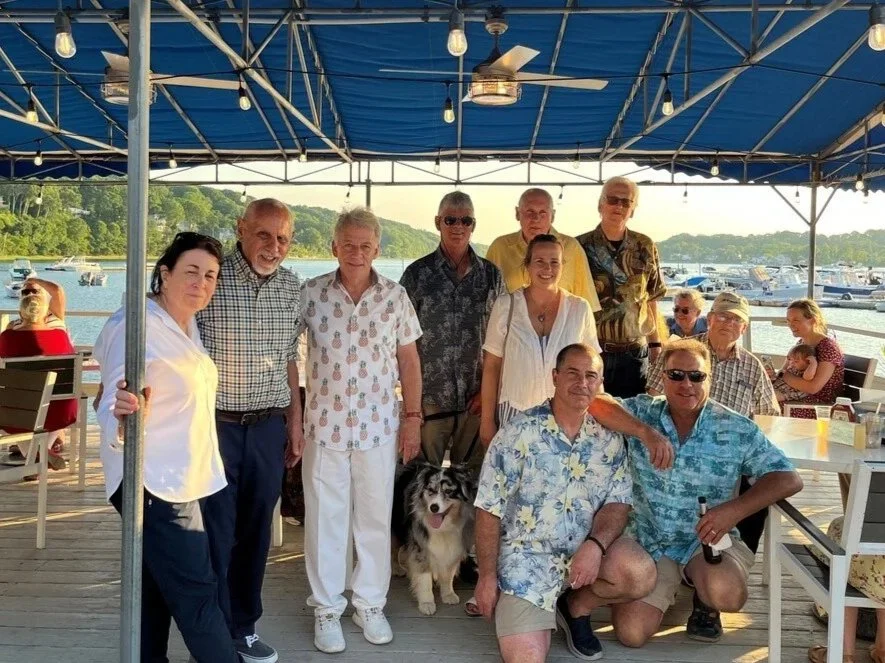
Friends of the Bay is a 501(c)(3) nonprofit organization. Approximately 90 percent of our operating budget comes from donations and grants. We have a staff of two paid full-time employees: an executive director and a program coordinator. Our board of directors is comprised of fourteen community leaders who donate their time and expertise to the organization without compensation.
We accomplish this through:
Environmental advocacy
Water-quality monitoring
Shellfish restoration
Preparing and assisting in long-term plans for the bay and harbor
Educational programs and outreach
Beach cleanups and marine debris removal
Local wildlife monitoring
Our Mission
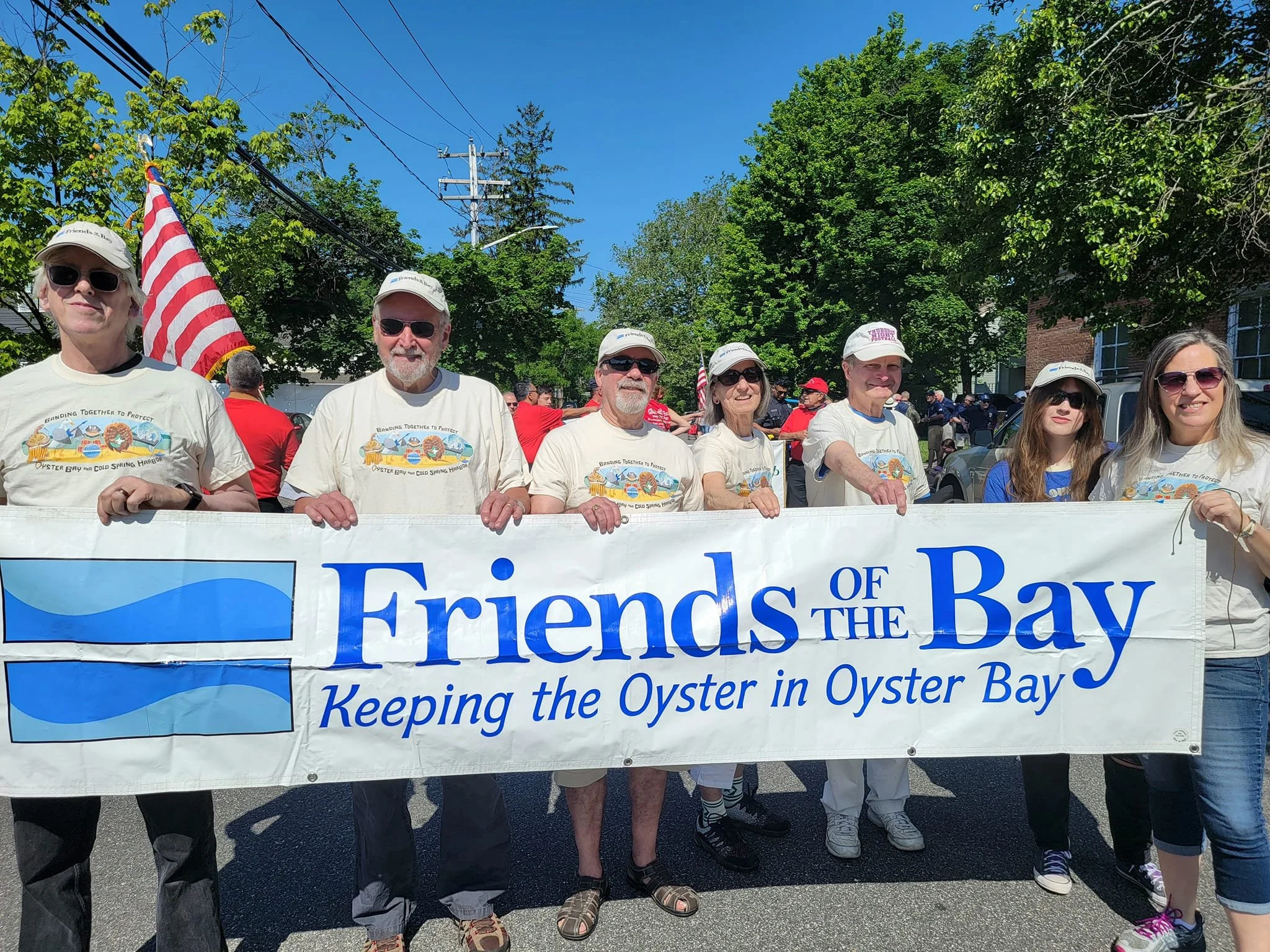
Friends of the Bay’s mission is to preserve, protect and restore the ecological integrity and productivity of the Oyster Bay/Cold Spring Harbor Estuary and surrounding watershed.
What We Do
FOB’s recent advocacy has included:
Establishing shellfish sanctuaries in Oyster Bay, Mill Neck Creek and Cold Spring Harbor.
Enacting a temporary moratorium on shellfish harvesting on the bay bottomlands formerly leased to Frank M. Flower & Sons.
We have advocated for establishing shellfish sanctuaries where harvesting would be banned in perpetuity because shellfish populations, particularly oysters, have declined dramatically. The sanctuaries would provide a place for these bivalves to grow, reproduce and provide larvae to rebuild sustainable shellfish populations.
Friends of the Bay conducts water quality monitoring in Oyster Bay and Cold Spring Harbor. The organization also sponsors community events that take place on the water and beaches and it works with citizens and local government officials for wetland restoration and habitat protection. We are monitoring development plans for the Eastern Waterfront, involving the public, landowners, and town and state governments.
We believe the expiration of the Frank M. Flower & Sons town lease for most of the bay will be an unprecedented opportunity for more sustainable harvesting options. We supported the town’s enactment of a temporary moratorium on shellfish harvesting on those bottomlands on October 1 to allow for a professional scientific survey to determine what shellfish, if any, remain on the bay bottom and the best areas for shellfish restoration and sanctuaries. In the meantime, baymen and recreational harvesters will still have access to areas outside the former lease that they have always had.
FOB has supported shellfish restoration projects:
North Shore Oyster Gardening Program.
“Oyster Habitat Restoration and Monitoring Utilizing Spawner Sanctuaries in Oyster Bay and Cold Spring Harbor,” a two-year project led by Adelphi University professors.
“Putting the Oyster Back in Oyster Bay,” a three-year project now in its first year led by professors from the Stony Brook University School of Marine and Atmospheric Sciences.
Supporting Oyster Aquaculture and Restoration (S.O.A.R) and S.O.A.R 2.0 administered by The Nature Conservancy and Pew Charitable Trusts.
Because we feel education and outreach are important, FOB hosts monthly beach cleanups, speaker presentations, leads kayak conservation cruises and nature walks. In 2021 FOB launched Team Terrapin to monitor the diamondback terrapin population at Centre Island Beach.
Our Story
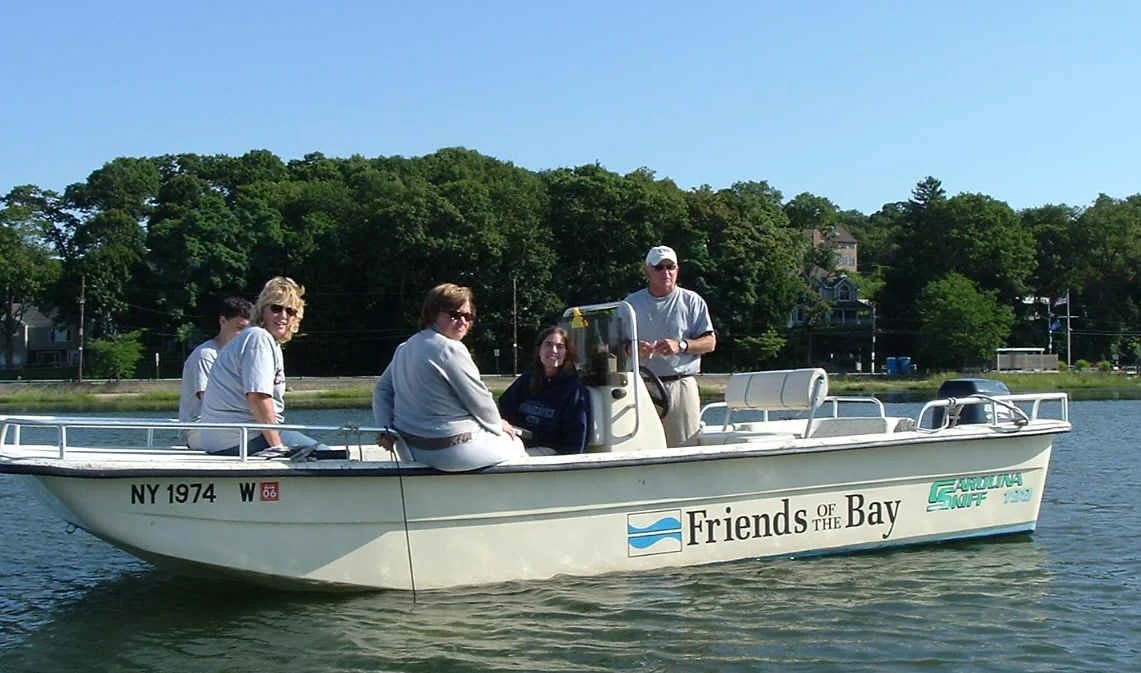
Friends of the Bay (FOB) was formed in1987 by a group of citizens concerned about the impact of a proposed development at the former Jakobson Shipyard site on Oyster Bay’s Western Waterfront. The plan was ultimately defeated in 1990, and in 1997 the Town of Oyster Bay and the State of New York acquired the property. FOB then led the public process that resulted in the Land Use Plan for The Oyster Bay Western Waterfront. This included the development of a public park, boat ramp and the WaterFront Center to promote sailing and education.
Read more about our story
The History of Friends of the Bay
By Danielle Ranucci
In 1987, a small group of citizens became concerned about the impact of a proposed development at the Jakobson Shipyard site on the Oyster Bay waterfront. The group, spearheaded by former clammer Ralph Naranjo and Centre Island Mayor Jack Williams, responded by forming the non-profit group Friends of the Bay.
In the economic turmoil of that era, the project—including a marina, restaurant and hotel—would have generated revenue from tourism and taxes paid by the developers.
But the potential pollution could have harmed the marine ecosystem, possibly taking the oysters out of Oyster Bay. The degradation also could have imperiled Long Island's sole remaining oyster company and the livelihoods of its employees and the independent baymen who harvested shellfish in Oyster Bay.
Although local officials supported the development, Friends of the Bay generated significant public opposition by holding meetings and educating residents about the project's potential impacts.
“Our members saw a real issue here, and that struck a chord with the community,” then-FOB Executive Director Rob Crafa said. “That’s why there was an outpouring of support.”
The citizens who attended the meetings raised concerns ranging from environmental damage to their livelihoods to preserving the bay’s aesthetic beauty to wanting a place where they could teach their children how to swim.
“Let’s err on the side of caution…to have a place we can leave to our children,” clammer Tom Eagan said in a 1989 meeting.
After the development plan was defeated in 1990, Friends of the Bay led an extraordinary public process that resulted in the “Land Use Plan for the Oyster Bay Western Waterfront.” It called for the Town of Oyster Bay to purchase Jakobson Shipyard and build a marine education center where children could learn to swim, sail and protect their environment.
In 1992, the organizers of the annual Oyster Festival brought America's oldest oyster sloop, the Christeen, back to its fishing grounds in Oyster Bay. In 1996, Friends of the Bay helped create the Christeen Restoration Group. This group, headed by Harbormaster Clint Smith, refurbished the National Historic Landmark vessel over the next eight years.
Before the restoration, “It was a dilapidated old wooden boat,” Crafa said, “and one of my jobs was to pump the boat out [...] to keep it floating.”
The Town of Oyster Bay and the State of New York finally acquired Jakobson Shipyard in 1997. “The restoration and preservation of this property is a long-sought victory for Friends of the Bay and the realization of a decade of hard work and a shining example of what can be achieved with perseverance and a clear vision,” FOB President Jack Williams said at the time.
In the same year, FOB received the National Oceanic and Atmospheric Administration's prestigious Walter B. Jones Memorial Excellence Award for Coastal and Resource Management.
Over the next few years, Friends of the Bay assisted the Town of Oyster Bay to complete its state-funded “Land Use Plan for the Oyster Bay Western Waterfront.” FOB also realized its long-held dream by creating the 25,000-square-foot Center for Marine Education and Recreation (which became The WaterFront Center) on the north side of West End Avenue.
“The educational piece was always one of our cornerstones because the more you educate people about the bay, the more likely they are going to want to keep it healthy and strong,” said Beth Dalton-Costello, FOB board member and past president.
In 1999, Crafa, serving as environmental coordinator under Executive Director Denise Woodin, began FOB's Water Quality Monitoring Program. This citizen science program was designed to obtain scientific data to substantiate the organization’s proposals and initiatives. It continued to grow and expand, and it would be recognized by the US EPA Region 2 with an Environmental Quality award in 2009.
“The Water Quality Monitoring Program really forms the basis for programming and outreach even now, 20 years later,” Crafa said.
In 1999, with the support of a Long Island Sound Study grant, Friends of the Bay developed a septic education program. This initiative targeted homeowners in the Locust Valley subdevelopment known as Continental Villa, which historically had malfunctioning onsite wastewater systems that harmed Mill Neck Creek. This program was prescient, ahead of the 2012 Get Pumped Long Island! Campaign, the Reclaim our Waters initiative in Suffolk County and the upcoming Nassau SEPTIC program promoting advanced treatment systems.
In October 2000, the fully restored Christeen was launched “under a rainbow that stretched over the bay and to the cheers of hundreds of supporters,” trumpeted the Spring 2000 edition of FOB's Baywatch newsletter.
The Christeen, now operated by The WaterFront Center, provides environmental education and pleasure sails for thousands of people annually.
In 2001, Friends of the Bay hosted the First Annual Bay Day—a community festival at Beekman Beach. There were free rides on the Christeen and a second “Anything that Floats” race, where teams of students, corporate sailors and community groups built and raced makeshift boats.
In 2002, Friends received an EPA grant for an education campaign promoting the use of “bilge socks” to absorb oil and gas in a boat’s bilge.
In 2003, FOB received a State Environmental Protection Fund grant to perform outreach and education about the Mill River Watershed Study and Public Stewardship Program.
In the same year, the organization expanded its focus from protecting just the harbors to preserving the entire Oyster Bay-Cold Spring Harbor watershed. “All the water that rains and snows onto and flows through the groundwater and surface watersheds of Oyster Bay and Cold Spring Harbor eventually will make its way into our estuary,” then-FOB Executive Director Louise Harrison wrote.
The threats to the estuary were highlighted when Defenders of Wildlife selected the Oyster Bay National Wildlife Refuge as one of 2005’s ten most threatened refuges in the country.
Key to this nomination was Friends of the Bay’s water quality monitoring in Mill Neck Creek. The data showed that a housing development in Locust Valley, known as “The Birches,” had inadequate septic treatment, which resulted in pollution. In 2008, The Birches connected many homes to the Glen Cove Sewage Treatment Plant. Thanks to its monitoring, FOB was then able to show that this connection had improved the water quality.
In 2009, Friends of the Bay worked with the consulting firm of Fuss & O’Neill to create a State of the Watershed document. This assessed environmental conditions throughout the estuary and surrounding watershed.
The document became the basis for a 2011 Watershed Action Plan, prepared by FOB and its consultants. The plan was finalized with the cooperation of Nassau and Suffolk counties, the towns of Oyster Bay and Huntington and 13 incorporated villages.
“A lot of times you might do a Watershed Action Plan and it would just be one town or one county, but this was quite a large initiative,” said Pat Aitken, FOB executive director at the time.
“The report acknowledged that you couldn’t just jump right in and start fixing things,” said Paul DeOrsay, who became executive director after Aitken. “You had to build capacity.” FOB continues working with the town and other agencies to achieve the plan’s goals while updating it.
One of the key recommendations of the Watershed Action Plan was the creation of an intermunicipal Oyster Bay/Cold Spring Harbor Protection Committee. On August 8, 2012, Nassau County, the towns of Oyster Bay and Huntington, the City of Glen Cove and 13 villages signed a memorandum of understanding officially creating this protection committee. It was established with the support of a 2010 Long Island Sound Futures Fund Grant. FOB has been active on the committee since its inception.
In 2012, the Town of Oyster Bay received a grant as the lead agency for an unprecedented partnership between three Long Island watershed protection committees—Manhasset Bay, Hempstead Harbor and Oyster Bay/Cold Spring Harbor. The grant allowed Friends of The Bay to implement a Coordinated Environmental Solutions for Septic Problems Occurring on Long Island (CESSPOOL) project.
To help protect fish populations, FOB and the Nature Conservancy built a fish ladder at Beaver Dam at the head of Mill Neck Creek between 2015 and 2017.
In 2018, FOB Executive Director Heather Johnson and future FOB board members Bill Bleyer and John Taylor created the Coalition Against an UnSound Crossing to oppose Governor Andrew Cuomo’s proposal for a tunnel from Long Island to Westchester. The coalition is a highlight of FOB’s recent advocacy work.
“The impacts of the project would have included an increase in traffic, a decrease in air and water quality and possible compromising of our single-source aquifer,” Johnson said.
Cuomo scrapped the project the day after the coalition held its first press conference.
In 2019, FOB began monthly beach cleanups in the warmer months.
In 2020-21, the organization revived its Speaker Series, created a Team Terrapin with the town to protect diamondback terrapins and obtained a grant to use drones to find sources of illicit discharge into the watershed. It also received a donation of underwater drones to monitor disturbances of the bay bottom. The organization started a membership program, revamped its website including FOB's first online store and launched community programs such as Kayak Conservation Cruises in conjunction with The WaterFront Center.
Since its founding, Friends of the Bay has grown into a powerful voice representing approximately 3,000 members and donors.
Looking forward, FOB President Bill Bleyer says the group's primary focus will be the creation of a Bay Management Plan by the Town of Oyster Bay. The plan would cover the granting of licenses for shellfishing, expanding hatchery operations and all other environmental issues affecting the bay. The town has agreed to create the plan and FOB has been promised representation on the advisory board.
"I am excited for our future," said Bleyer, who became president in January 2020. "We will continue to work to make Friends of the Bay a more visible and influential advocate for the watershed."
January 2021
FOB communications intern Danielle Ranucci is a student at Princeton University